
Pedogenic developmental variation through a novel Loess-Palaeosol Sequence in Kolobar, Bulgaria, since the Mid-Brunhes Event (430 kyr) assessed by geochemical proxies
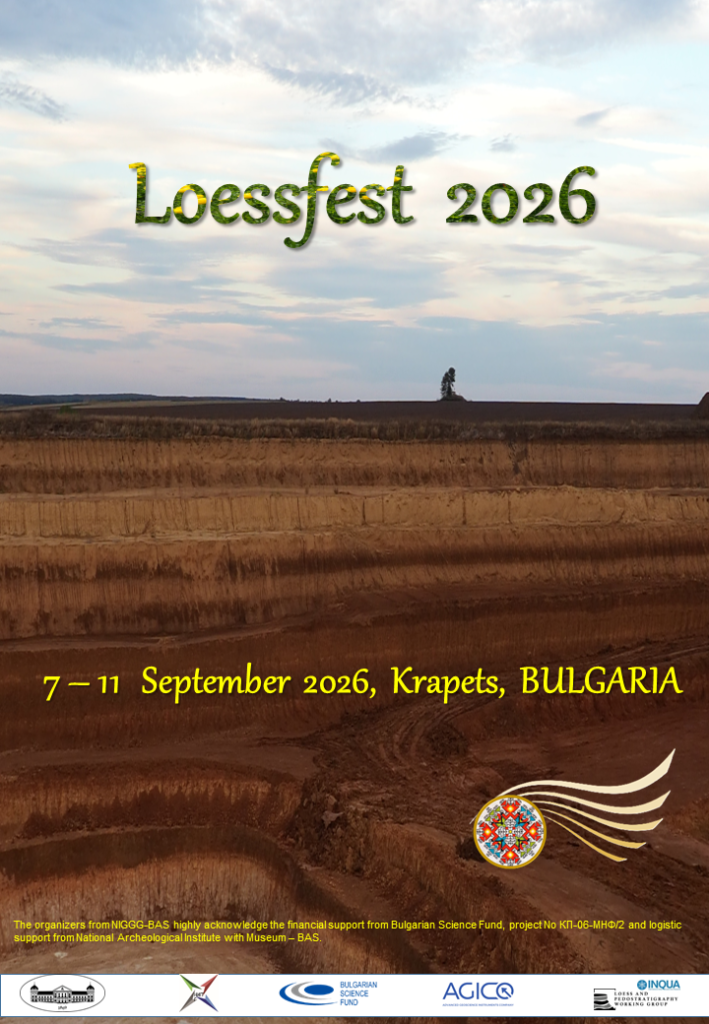
Loess Fest 2026, September 7 – 11, Krapets, Bulgaria, DOI: 10.48368/loess-2026.n26
A. Trott, L. Buchmann, B. Georgieva–Ishlyamska, Y. Baykal, M. Robu, D. Ishlyamski, N. Jordanova, U. Hambach, D. Veres, D. Jordanova, G. L. B. Wiesenberg
Abstract:
The loess-palaeosol sequences of the Lower Danube–Black Sea (LDBS) region preserve a continuous, high-resolution record of regional climate change and environmental variability through the last >400 kyr. Throughout this period, the region has been variably influenced by multiple climate regimes, including the Mediterranean cyclonic region, central European westerlies, and western Asian continental air masses. However, despite its significance, geochemical characterisation of this region remains sparse, and high-resolution multi-proxy datasets are limited and climate predictions for this region remain poorly constrained.
Here, we present X-ray fluorescence (XRF) and complementary photospectrometry data at 2 cm resolution, alongside a novel age-depth model, for 12 m of a newly opened LPS near to the village of Kolobar, Bulgaria. Through these datasets, we aim to develop our characterisation of the sequence and provide insights into variations in pedogenic and weathering intensity, and dust provenance, providing a means to delineate palaeosol and loess units, and providing evidence of tephra layers. To achieve this, we apply a suite of geochemical indices, including the Chemical Proxy of Alteration (CPA) for silicate weathering intensity and Ti/Zr ratios for provenance shifts, with additional elements and elemental ratios (e.g. Fe/Mn, Ca/Ti, Cl) to assist in the characterisation of redox conditions and carbonate dynamics throughout the sequence.
We observe distinct variation between loess and intercalated palaeosols, reflecting differing pedogenic development and conditions. Rb/Sr indicates intense carbonate weathering in palaeosols, with loess units remaining comparatively enriched. This, alongside similar responses in the Mg/Ca ratio reflecting the leaching of carbonates, indicates increased moisture during periods of palaeosol development. Additionally, the Chemical Proxy of Alteration shows considerable scatter throughout the sequence yet shows consistently higher values in palaeosols with additional variation between palaeosol units. A pattern which is also seen within the Fe/Al ratio for pedogenic oxidation. This variation indicates varying pedogenic conditions with differing units experiencing differing degrees of clay formation, potentially as a result of palaeohydrological fluctuations between interstadials. Transitional zones show that the top of palaeosols into unaltered loess is typically sharp, on the order of 10 cm, whilst the base of the palaeosols transitions gradually into underlying loess. This differing behaviour suggests abrupt shifts in depositional material and/or environment were common from interglacial to glacial periods.
Despite the heterogeneous nature of the LPS, as reflected in weathering indices, the provenance of the material (as seen in the Ti/Al and Ti/Sr ratios) appears to be consistent throughout the sampled profile, suggesting a relatively homogenous parent material for the varying units. Together, these results demonstrate that the Kolobar sequence preserves a high-resolution, geochemically distinct record of glacial-interglacial pedogenic cycles, and establish XRF-based proxies as an effective tool for characterising palaeoenvironmental change in this previously understudied region.
How to cite:
Trott, A., Buchmann, L., Georgieva-Ishlyamska, B., Baykal, Y., Robu, M., Ishlyamski, D., Jordanova, N., Hambach, U., Veres, D., Jordanova, D., & Wiesenberg, G.L.B. (2026). Pedogenic developmental variation through a novel Loess-Palaeosol Sequence in Kolobar, Bulgaria, since the Mid-Brunhes Event (430 kyr) assessed by geochemical proxies. Loess Fest 2026, September 7–11, Krapets, Bulgaria. https://doi.org/10.48368/loess-2026.n26