
High-resolution magnetic and geochemical study of magnetic depletion in the S4 paleosol of the Kolobar loess–paleosol sequence (NE Bulgaria)
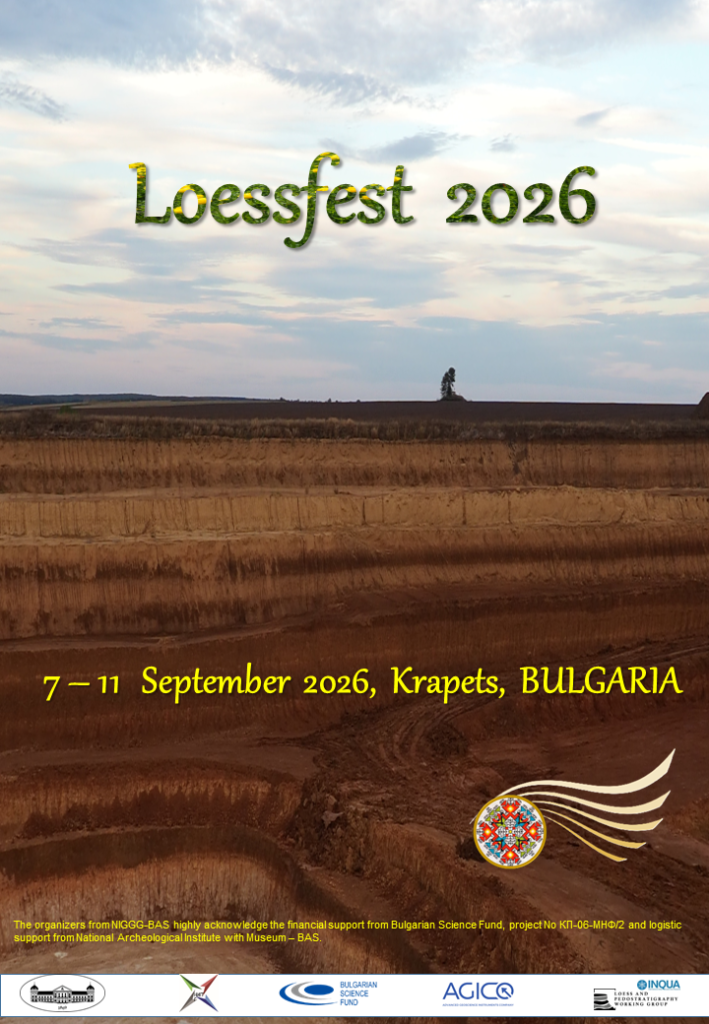
Loess Fest 2026, September 7 – 11, Krapets, Bulgaria, DOI: 10.48368/loess-2026.n55
B. Georgieva – Ishlyamska, A. Trott, N. Jordanova, D. Jordanova, D. Veres, Y. Baykal, M. Robu, U. Hambach, D. Ishlyamski, G. Wiesenberg
Abstract:
Loess–paleosol sequences (LPSs) are valuable terrestrial archives for reconstructing Quaternary environmental and climatic change. In southeastern European LPSs, soil horizons generally exhibit enhanced magnetic susceptibility due to the formation of fine-grained ferrimagnetic minerals. Under specific paleoenvironmental conditions, however, paleosols may exhibit magnetic depletion.
To investigate the processes responsible for magnetic depletion, this study focuses on the fourth paleosol (S4) of the Kolobar loess–paleosol sequence in northeastern Bulgaria. The entire sequence was continuously sampled at 2 cm resolution, while the present study focuses on a 3 m thick interval comprising the L4 loess, the S4 Vertisol and the underlying S5 paleosol. The L4–S4–S5 interval was investigated using an integrated mineral magnetic and geochemical approach, including magnetic susceptibility, laboratory remanences (ARM and IRM), grain-size-sensitive magnetic ratios (ARM/χ, ARM/IRM), S-ratio, and FeO concentrations determined by XRF analysis. Evaluation of the content of organic matter was achieved using Loss on Ignition (LOI) data. Magnetic proxies consistently indicate depletion of the pedogenic ferrimagnetic fraction within the S4 paleosol relative to the underlying S5 paleosol and the overlying L4 loess. The coupled decrease in magnetic susceptibility and FeO content throughout S4 indicates mobilization and partial removal of secondary pedogenic iron oxides during Vertisol development. Lower ARM/χ values indicate a trend of depletion of fine-grained pedogenic ferrimagnetic particles along depth, whereas increasing ARM/IRM ratio and decreasing S-ratio suggest a progressively greater relative contribution of true single domain magnetite and high-coercivity minerals toward the base of the paleosol. In contrast to the L4 loess, where FeO is negatively correlated with IRM, the S4 Vertisol exhibits a positive linear relationship between FeO and IRM. This contrast suggests that iron in L4 is predominantly hosted by the paramagnetic phyllosilicate matrix, whereas in S4 it is mainly associated with secondary pedogenic iron oxides that were subsequently mobilized and partly removed during Vertisol development.
Acknowledgements:
The team of LOEs-CLIMBE project № IZ11Z0_230102 gratefully acknowledges the financial and institutional support provided in the framework of the second Swiss Contribution to selected EU member states (funding scheme MAPS).
How to cite:
Georgieva–Ishlyamska, B., Trott, A., Jordanova, N., Jordanova, D., Veres, D., Baykal, Y., Robu, M., Hambach, U., Ishlyamski, D., & Wiesenberg, G. (2026). High-resolution magnetic and geochemical study of magnetic depletion in the S4 paleosol of the Kolobar loess–paleosol sequence (NE Bulgaria). Loess Fest 2026, September 7–11, Krapets, Bulgaria. https://doi.org/10.48368/loess-2026.n55